Showing posts with label Analytical Essays. Show all posts

Friday, March 27, 2009

A Note From the Author

For perspective publishers interested in publishing my complete work on the Bathynomus Giganteus as well as my expanded views on the Isopod psyche in general should write to me at:
Beaufort House, 3 Middlesex Street
London, UK (above the ramen house)

Or call me at 020-7247-7065 (ask for resident upstairs and they'll know what to do. Be prepared to wait a few minutes as I cannot walk down the three flights of stairs in seconds) It's best to call before 3 as that's when they close and I have a great deal of difficulty hearing the phone from all the way upstairs, especially during the winter when my windows are closed.

You may also write to me at the same address. Again, be very clear that you are attempting to reach me and not the ramen store, or they'll think you're trying to order something and will charge you for three large bushels of ramen whether you want them or not. It may take me several weeks to respond as I often do not receive my mail until weeks after it has been delivered and they will steal my outgoing mail just to be annoying (as if my life isn't difficult enough).

I also have a thesis in progress about the effects of the common house cat on the emotional well-being of the modern woman between the ages of 35 and 55.

Telemarketers and other spammers need not reply. I find the entire business most offensive; you should be ashamed of yourselves and I'm sure your mothers are.


Join me in my journey to unleash my inner potential through my passion for the Bathynomi!

A Few Bathynomus Resources

Resources:
Giant Isopods Ate My Well-Known Brand of Corn Chip
(Song from forthcoming CD "Songs About Giant Isopods" with entertaining music video)
http://en.wikipedia.org/wiki/Giant_isopod
While I know it is somewhat risque to cite Wikipedia, it has many useful facts and an interesting insight into how the general public views our crustaceous friends.
http://blogs.discovery.com/deep_sea_news/2007/04/from-the-desk-o.html

Very nice, quick overview of the Bathynomus with fun photo illustration.

Guide to the marine isopod crustaceans of the Caribbean

Books I found from a public library. I have not actually read them, as I don't speak German, but they could be useful to the industrious Bathynomus scholar.

Verhaltensstudien am Grauen Riesenkänguruh, Macropus (Macropus) giganteus : Gefangenschaftsbeobachtung

Die 23S-ribosomale [S-ribosomale] RNS, ein phylogenetischer Marker Klonierung und Sequenzierung von 23S-rRNS-Genen aus "Deinonema spec.", Herpetosiphon giganteus und Flexithrix dorotheae

Transformation von Aspergillus giganteus und molekulargenetische Charakterisierung sekretierter, cytotoxischer Proteine

And for those with a greater love for bats than Bathynomi:
The rhythmically active metacarpal bat vein as a model for the study of venous smooth muscle function and peripheral autoregulatory flow mechanisms


Our Brothers Below: An Exposition on the Bathynomus Giganteus and its Prehistoric Origins Part II

Did they ever see sunlight. Were the Bathynomi originally land creatures who went into the sea? Did they leave loved ones behind in the great migration sea-ward? Was there some great rift with trilobytes that banished them? I often wonder what it would have been like for a bathynomus to see the sunlight above him as he scavenged for food. Would he notice the sun's rays, or only the time of day? Would he revel in how the light bounced off fish's scales, or only look to see if one was dead? Now, of course, they are effectively blind. But I wonder if, sometimes, a Bathynomus has a prehistoric memory of sunlight stored in its DNA for millennia, much like childhood memories or events long past.

The Bathynomi are solitary creatures, mostly living alone except for mating periods. I wonder if the fathers ever wish they, too, could hold eggs in brood pouches. Or do they leave after sex, without a second thought or look at their once-mate? Do the mothers transfer some sort of Bathynomus identity onto the children? Do they show their great history, long evolutionary journey and amazing efficiency as marine creatures? Do they pass along tips for surviving? Not just physically, but emotionally? How to survive as an asocial deep marine animal. How to live without friends or family, how to enjoy life without any hope of connection with another Bathynomous, or even Isopod in general. Their sex lives are uneventful and almost completely unknown. Perhaps they have special dances or courtship rituals, strange movements from ancestors that create, however briefly, a beautiful culture of Bathynomi in which pod and pod are one. Do they glide through currents, touching one another' s exoskeletons with feelers? rubbing leg with leg?

Do they resent the Mitrella amphisella for feeding off them? Do they attempt inter-species outreach with the eels and lobsters that share their diet? These are many questions that I wonder, and which I challenge other scientists to answer as we continue to explore deep sea life. Together, we can make the voyage underwater, back in time, to discover the life of the Bathynomus Giganteus.


Thank You.

Our Brothers Below: An Exposition on the Bathynomus Giganteus and its Prehistoric Origins Part I

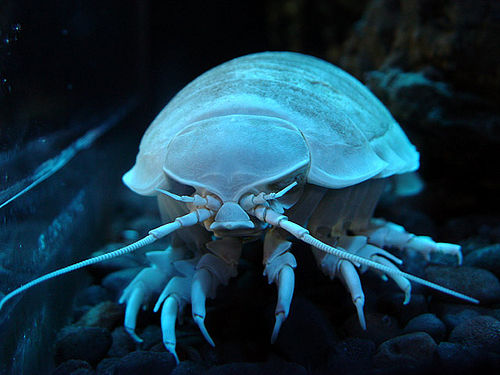
The Bathynomus Giganteus is a specie of isopod that lives on the deep ocean floor.  Because of the great depths at which it resides, the Bathynomus grows to far larger sizes than its evolutionary cousins.  It has often been called the cockroach of the ocean, but a more apt name would be a subterranean maid.  The Bathynomus eats the dead fish that float down from warmer waters, taking what most other animals would not consider eating. 

     But the point of my lecture today is not the merits of the Bathynomus in oceanic ecosystems.  Rather, I want to discuss its extraordinary evolutionary history and how it has come to be one of the most ancient and unevolved species in existence.  I also want to take away some of the stigma associated with being "unevolved."  Instead of thinking of the Bathynomus as a giant dissapointment in the timeline of life, I'd like to look at this creature as one of the early starters in the race toward survival.  It came into success early on in relation to other life forms, and it was so successful that it has needed no changes in over 60 million years. 

     Imagine what it must have been like when the Bathynomus first began foraging for food on the ocean floor.  Yes, of course there was no one singular moment when it was no longer just an isopod and officially the Bathynomus Giganteus.  In fact, that is one of the things I love about the Bathynomus, and evolution in general.  It was quietly evolving, changing, creating an exoskeleton, feeding on other prehistoric creatures, sharing the waters with their cousins the trilobytes.  what must it have been like for them to roam the sandy depths in their new form?  And now, so many years later, do they feel a connection to their brothers from so long ago?  Do they somehow remember those first few moments when their feet touched the sand (though they do not have feet, I find this metaphor very moving) and they were the Bathynomus?  Unlike humans, they have lived for millions of years, most of those years without change. 

Please stay posted as I continue my essay on the Bathynomus Giganteus